
The bathroom is one of the most mobile obstructions in the home and can present safety problems due to the slippery surfaces, sharp edges and odd configurations that are required to complete personal care activities. The bathroom can become a place of fear, discomfort or even physical harm for older people and people with disabilities.
Making the appropriate modifications to bathrooms in order to increase accessibility not only ensures that individuals are safer when completing daily tasks, it also gives them back their dignity and confidence in their ability to complete their personal care.
Safety modifications that work immediately
Grab bars for the bathroom are an essential safety feature that can be used in a number of locations around the bathroom including next to the toilet, in the shower and at the end of the bath where people enter and exit the bath. Grab bars can be used as support when transferring from one place to another. It is very important to choose grab bars that have a weight capacity of at least 135kg and that are fixed into the wall studs with screws. This will ensure that the grab bars do not fall and cause injury.
To prevent slips in the shower or around the bath, non-slip surfaces should be applied to the relevant areas. These are available in the form of strips or stickers with a textured surface and are very easy to fit and will not leave any marks or stains on the surfaces that they are applied to.
Toilet raisers are available in a variety of different heights. These can increase the seat height of your toilet by as little as 5cm or as much as 10cm. By increasing the height of the seat of your toilet, these toilet raisers can help to make it easier for you to both sit down and stand up from your toilet.
Shower adaptations
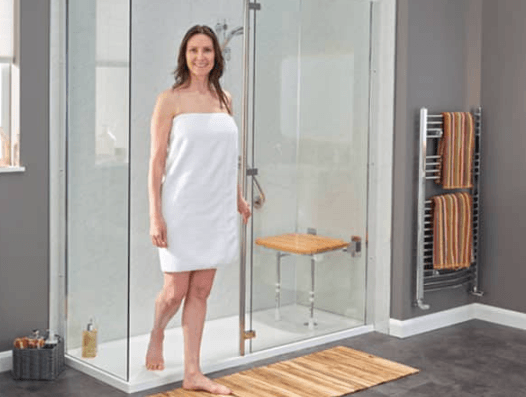
A walk-in shower is also an easy modification to make a bathroom more accessible when a full bathroom renovation is not planned. A seat or bench in the shower can be used to sit down for showering and to prevent falling. A long arm hand-held shower head with a cord of sufficient length to reach all parts of the shower, and even better with a bar on the wall to hold the head in place while cleaning different parts of the shower, can also be used to prevent to much mobility in the shower to prevent excessive fatigue.
Independence through thoughtful product selection
These items can be used to further aid independent living. While they can be used to increase safety, their primary function is to increase the independence and dignity of people with limited mobility by allowing them to complete their own personal care, as required.
Long handled brushes and cleaning tools allow users to clean high areas without having to stoop or bend. Soap dispensers, which are mounted at an accessible height, can be used instead of slippery soap bars. Even simple bathroom products can greatly increase the independence of people with mobility problems.
Other toilet tissue aids and bidets are designed to meet the personal hygiene needs of people with limited flexibility. A large range of high quality bathroom aids are available on the market which aim to restore dignity to people whilst enabling them to maintain their personal standards and complete their toileting in the manner in which they see fit.
All of the items listed for the bathroom can be found and purchased to meet the highest of personal standards enabling users to carry out their personal hygiene in the same manner as they would do should they not be limited by flexibility in the bathroom.
See also: The Risks of Web3 Adoption
Lighting and visibility considerations
Aging in place often results in a decline in the person’s visual acuity. Good lighting in the bathroom is necessary for older people to safely perform their personal hygiene. A motion-activated night light could be placed on each side of the bathroom to allow people to safely move around at night.
Using contrasting colors for objects and their backgrounds is also important for people with sight loss. Using a dark toilet seat against a light toilet fixture, for example, will help people with sight loss recognize the edges of the toilet seat. The brightly colored grab bars against neutral-colored walls can also help people with sight loss recognize the location of the grab bars.
Storage and organisation for easy access
The typical bathroom storage solutions for toiletries require reaching, bending or stretching which can be difficult or even impossible for some individuals with mobility limitations. By installing wall mounted bathroom storage solutions such as soap, shampoo and conditioner dispensers the user will have all of the necessary bathroom items within easy reach without having to handle multiple containers. A pull down storage shelf or a rotating storage corner unit can also be used for bathroom storage and allow the user to access all of their bathroom storage without having to stretch or bend.
Storage solutions can also be equipped to higher positions to avoid patients having to reach down over a basin to retrieve medication, as shown right. Large, easy-open compartments on pill organizers aid people with limited dexterity when opening bottles and packing medicines.
Simple storage for towels is another important aspect for people with limited mobility. Instead of having to lift their arms over their head when putting away a towel, having a hook or towel rail at the right height can make all the difference.
Making gradual improvements work
Even when it is possible to carry out a full bathroom renovation it is not always necessary or affordable.
The most urgent problems to be solved in bathrooms to make them safe for older people are the installation of grab bars and non-slip surfaces. Elevating the toilet and provision of seating in showers are next. Most products on the market for accessible bathrooms are designed as ‘fixes’ that can be provided as temporary measures, often at very cost effective prices, in order to delay or avoid the need for residential care. So installing some grab bars and non-slip surfaces could make a huge difference.
Investing in quality bathroom products and making necessary changes to the bathroom environment can help to keep individuals and families independent for longer and in some cases delay or even prevent the need for moving into residential care. Simple changes can be made to the bathroom to help ensure that individuals can continue to live safely and independently in their own home.
